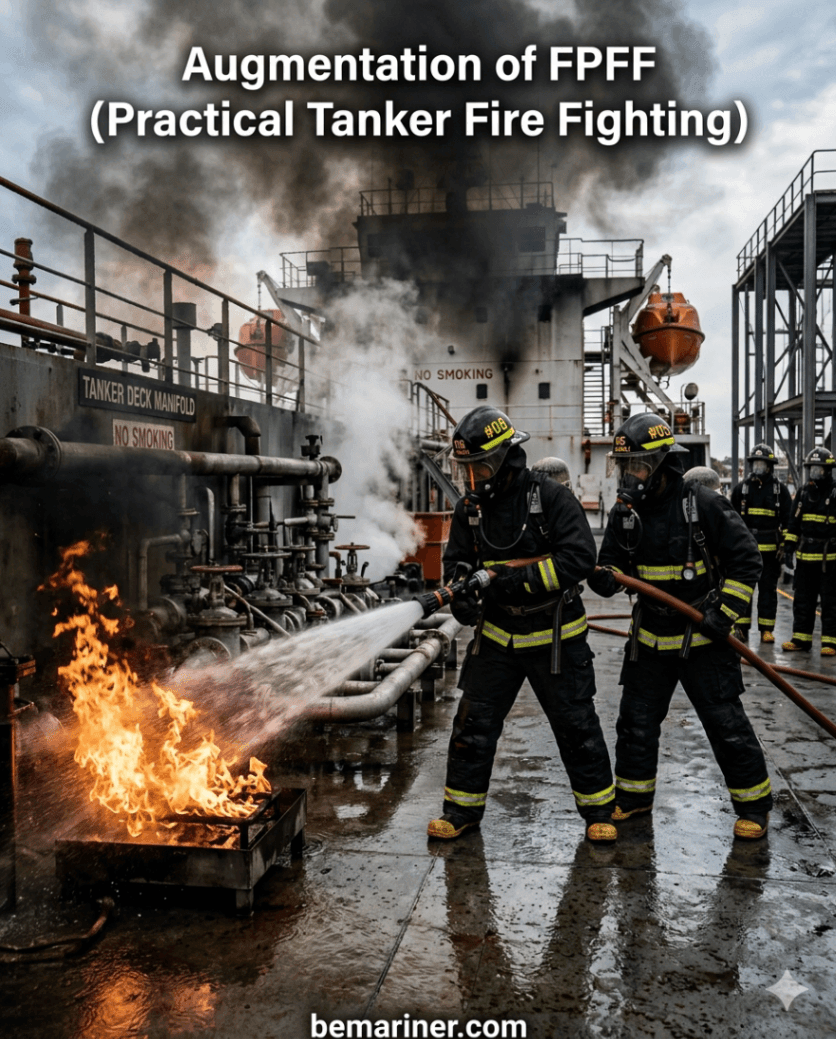
The Augmentation of FPFF (Fire Prevention and Fire Fighting) course is a specialized, mandatory practical training program designed specifically for seafarers transitioning into the high-stakes world of tanker operations. While the standard Basic Safety Training (BST) provides a foundation in general maritime firefighting, the Augmentation module focuses exclusively on the extreme and unique hazards associated with oil, chemical, and liquefied gas tankers. Regulated by the Directorate General of Shipping (DGS), India, and strictly aligned with STCW requirements, this intensive program bridges the critical gap between basic safety awareness and the advanced tactical skills required to combat fires involving highly flammable, volatile, and toxic liquid cargoes.
The curriculum is almost entirely hands-on, centering on "live-fire" drills within specialized tanker-mockup simulators that replicate the complex piping and deck layouts of real vessels. Trainees are taught to manage fires involving pressurized liquids, running fuel, and gas leaks—scenarios that require fundamentally different techniques than ordinary structural or cabin fires. A major emphasis is placed on the strategic application of specialized extinguishing agents, such as High-Expansion Foam and Dry Chemical Powders (DCP), alongside the correct use of water fog for cooling and vapor dispersion. Students also undergo rigorous practice with Self-Contained Breathing Apparatus (SCBA) in the confined and smoke-logged environments typical of a tanker’s pump room or engine spaces.
Successfully completing the Augmentation of FPFF is a non-negotiable prerequisite for obtaining a tanker endorsement on a seafarer's Continuous Discharge Certificate (CDC). It instills the technical confidence and muscle memory necessary to act as a disciplined first responder in an environment where a single mistake can lead to a catastrophic maritime disaster. By mastering these specialized firefighting tactics, maritime professionals ensure the safety of their crew, the integrity of multi-million dollar energy assets, and the protection of the marine environment.